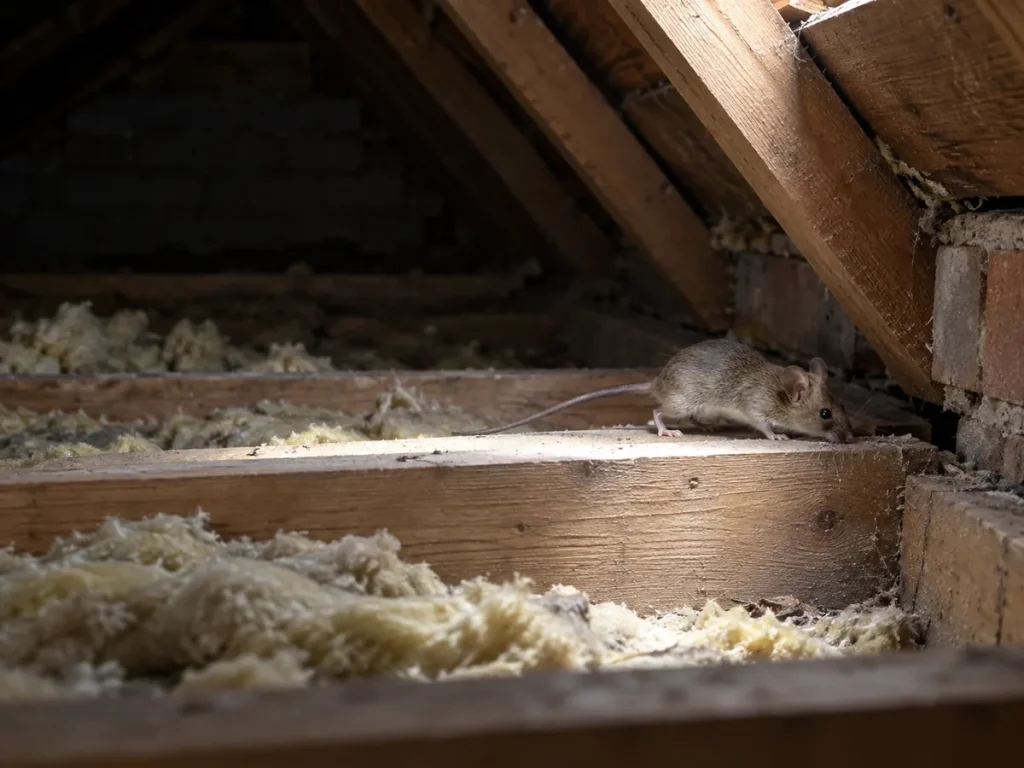
Mice in walls, under floors or in the loft are out of reach of most traps, so you get rid of them by treating the routes they use to come out, then sealing the gaps once they’ve gone. Here’s how we work out where they are, what works in each place and why you shouldn’t block the holes yet.
How do I know if mice are in my walls?
The signs are light scratching in one spot, small droppings along skirting boards, little holes at floor level and a musty smell in one room.
Mice like to nest where nobody looks: wall cavities, under floorboards and in lofts, as Fareham Borough Council points out. You’ll rarely see the nest, so we look for what they leave where they come out: droppings by skirting boards and kitchen plinths, gnawing on skirting or cables, and greasy marks around small holes.
If the main sign is the noise, our guide to scratching in the walls at night explains how to tell mice from rats by sound. If the droppings are closer to the size of a raisin than a grain of rice, it’s more likely rats: see rats in cavity walls.
How do mice get into walls and under floors?
Through gaps around pipes and cables, broken air bricks and gaps under doors. From there, cavity walls and floor voids give them a hidden route through the house.
A mouse needs a gap of just 5mm, according to the British Pest Control Association, and it climbs well. Creepers and rough brickwork take mice up to the eaves and into the loft.
Inside, the boxed-in pipes behind kitchen units and bathrooms, and the space under ground floors, link one room to the next.
How do I get rid of mice in my walls?
Treat where they come out, not where they’re living. Traps or bait go along the skirting, under units and by the holes, then the gaps are sealed.
You can’t put a trap inside a cavity wall, and we very rarely need to open one up. Mice leave the wall to feed, usually at night, so we treat the runs they use: along skirting boards, inside kitchen plinths, under the sink and by any holes we’ve found. Mice eat little and often, so it takes more points than a rat job.
This is also why DIY tends to catch a few mice and leave the rest. Plain trapping often isn’t enough for house mice, and the poisons sold to the public are restricted.
How do I get rid of mice under the floorboards?
Treat from the floor void’s access points, such as a hatch or a lifted board, and along the skirting above. Then mesh the air bricks rather than blocking them.
The gap under a suspended timber floor is a common nesting place, especially in older terraces, and the air bricks that ventilate it are often how mice get in. Blocking them stops the floor breathing and causes damp, so we cover broken or open air bricks with fine steel mesh instead.
How do I get rid of mice in the loft?
The loft is the easiest of the three to treat. Traps or bait go along the joists and the edges where mice run, then the way in is sealed.
Look for droppings on boards and along the joists, tunnels through the insulation and gnawing on cables. Mice usually get into lofts at the eaves, where pipes come through, or up through the cavity wall. Daytime noise in the loft is more often squirrels than mice.
What’s the smell coming from my walls?
A strong, stale smell from one wall or room usually means a nest or a mouse that has died in the void. It fades in time but can last weeks.
Mice that eat bait usually die in their nests, and the smell lasts until it fades, which depends on how warm the space is. Fareham Borough Council advises not trying to find the nest. A strong smell while mice are still active usually means a large infestation.
Should I block the holes?
Not yet. Blocking holes while mice are still inside can shut them in the wall, where they’ll chew a new way out or die there.
We seal the gaps once the activity has stopped, with wire wool set in quick-setting cement, as the British Pest Control Association recommends. Mice chew through expanding foam.
When should I call a pest controller?
Call when you can hear or smell mice but can’t reach them, when droppings keep turning up, or when anything electrical has been chewed.
Mice in walls and floors are the jobs DIY handles worst, because the nest is out of reach and the ways in are hard to find. We cover mouse control across Fareham, Gosport and south Hampshire: we find where they’re getting in, clear them and seal the gaps. Free remote quote, usually within ten minutes, with a fixed price agreed before we start.
If you’ve only seen a mouse and haven’t heard them, start with seen a mouse in the house?