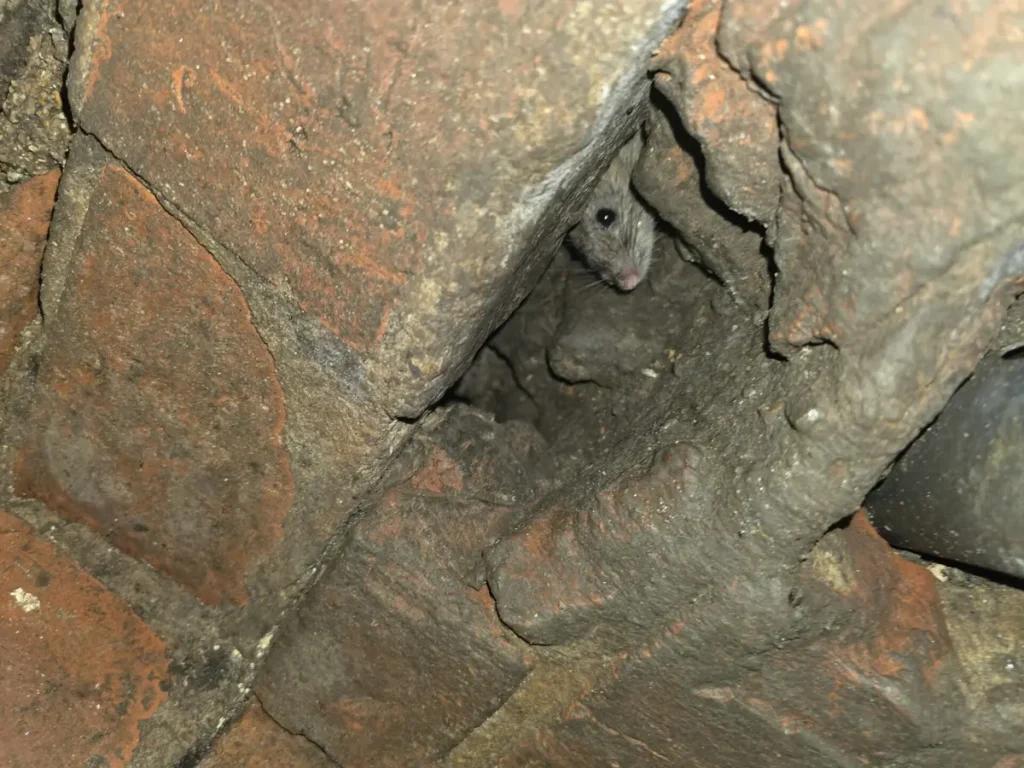
How do rats get into a cavity wall?
Most rats come up from below, through cracked or disused drains, then climb inside the cavity. Others get in through broken air bricks or gaps around pipes and cables. A rat needs a gap of only 15mm, according to the British Pest Control Association, so it’s the small gaps that matter.
In older houses around Fareham and Gosport, the usual culprit is old clay drainage. The pipes crack and their joints shift over time, and rats come up from the sewer into the space under the floor, then up the cavity. Disused drains, left open after a kitchen or bathroom has moved, are an even more direct route in.
Newer builds have a different weak spot. Plastic drainage is weaker than old clay pipe, and James finds rats chew through it quickly, which leads them straight into cavity walls and lofts. On any age of house, broken air bricks and unsealed gaps where pipes and cables pass through the outside wall are worth checking too.
What does a rat in a wall cavity sound like?
Rats make a heavier dragging or thumping sound that moves along the wall, while mice make lighter, quicker scratching that tends to stay in one area. The noise is usually worst at night, when the house is quiet and rats are most active.
If you can hear it above the ceiling as well as in the wall, they’re probably using the cavity to reach the loft. There’s more on telling the sounds apart in the guide to scratching in the walls at night.
Can rats chew through walls?
Not through brick or block, but rats will gnaw through plasterboard, timber, insulation, plastic pipes and cable sheathing. Their front teeth never stop growing, so they gnaw constantly.
The damage that matters is to what’s inside the cavity. The BPCA notes that rats strip the insulation from electrical cables, and cites an insurance-sector estimate that rodent damage to wiring causes 25% of electrical fires in buildings.
Are rats in the walls dangerous?
They can be. According to the British Pest Control Association, rats spread leptospirosis (Weil’s disease), salmonella and listeria, mainly through their urine. In a cavity, that means soiled insulation as well as the risk to wiring.
Will the insulation need replacing?
Sometimes. If rats have nested and the insulation is soiled, it may need to come out. If they’ve only been passing through, it can usually stay. Insulation replacement and other repairs aren’t part of the treatment, but James will tell you what he’s found and recommend the best course of action.
How are rats in a cavity wall treated?
James finds where they’re getting in, treats with bait or traps, checks back on follow-up visits, then seals the way in. Minor proofing, sealing gaps up to roughly the size of a tennis ball, is included in the treatment and covers most entry points. The only extra is a drain valve, which is usually the fix when rats are coming up from the drains.
In wall voids and lofts, where people and pets don’t go, bait can be laid open, because rats feed on it better there. Anywhere children or pets could reach, it goes in locked, tamper-resistant boxes. One thing to avoid in the meantime: don’t block the hole you can see before James has looked, because it hides the way in. You can read how a full treatment works on the rat control in Fareham and Gosport page.
How long does it take to get rid of rats in the walls?
Smaller problems usually clear in two or three visits over a couple of weeks. Long-standing infestations can take several weeks and more visits, because there are more rats to clear and often more than one way in.
Will the council deal with rats in the walls?
Fareham and Gosport councils both run a charged rat service, on weekdays only, and both currently warn that wait times are unusually long because of reduced staffing (checked October 2026). NJS answers the phone 24 hours a day.
How much does it cost to get rats out of a cavity wall?
Every job gets a free remote quote, usually within ten minutes, with a fixed price agreed before any work starts. Minor proofing is included. Drain valves, where they’re needed, are quoted separately. A photo of droppings, gnawing or the gap you think they’re using makes the quote quicker.
What have James’s customers found?
In most cases it comes back to one entry point, and finding and sealing it is what stops the rats coming back. Two of James’s Google reviews, word for word:
“My mum has been struggling with rats getting into her loft on and off now for the past 10 years, by means of 2 drains not in use anymore, we have used several people in the past, that haven’t dealt with it properly… had sorted the rats, and drains.”
Tracey C., Google review
“He found the entry point into our house and sealed it successfully. He cleared our attic and sealed up all the nooks and crannies.”
Wobble and Squeak, Google review
If you think you’ve got rats in the walls, James covers rat control in Fareham and Gosport, from finding the way in to sealing it. If it turns out to be mice, see mouse control.
Sources: British Pest Control Association, brown rat guide · Fareham Borough Council, pest control · Gosport Borough Council, pest control