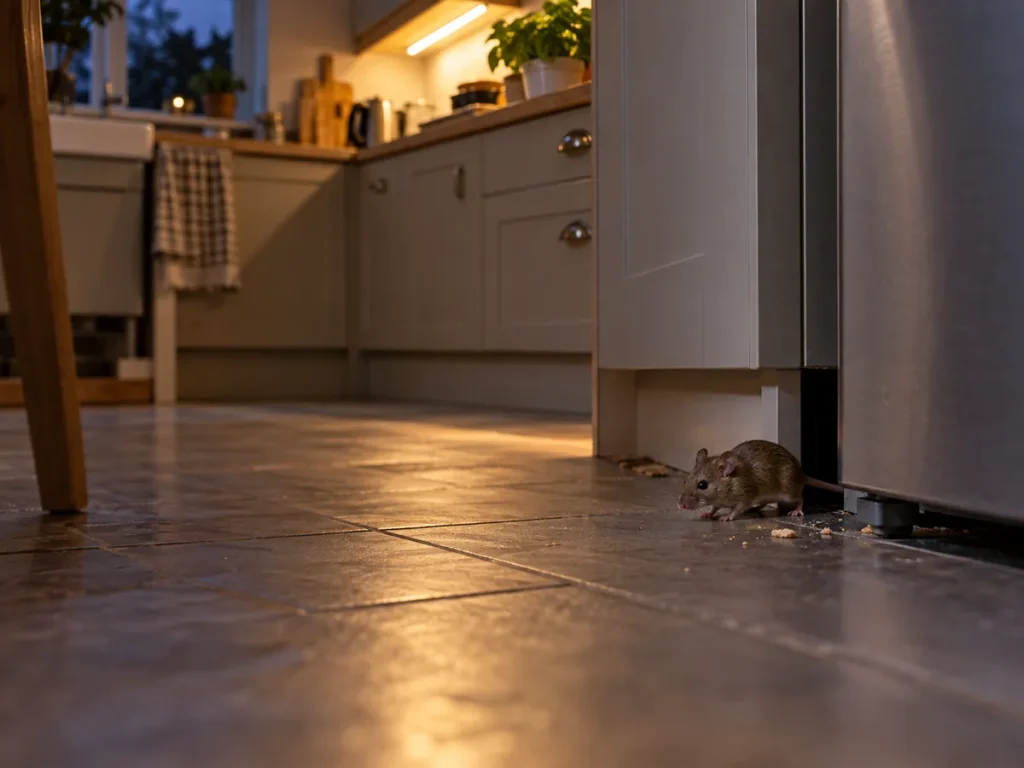
One mouse in the house usually means there are more. Mice are mainly active at night and stay close to food, so seeing one, especially in daylight, is often the first sign of a small infestation. Here’s how to check, what to do tonight and when it’s time to call someone.
Does seeing one mouse mean there are more?
Usually, yes. Mice are mostly active at night and keep out of sight, so the one you see is rarely the only one in the house.
When someone calls us about “just one mouse”, we treat it as more than one until the survey says otherwise. Mice breed all year round, mainly in spring and autumn, and the average litter is six, according to Fareham Borough Council. A pair that got in a few weeks ago can already be a family.
How can I tell how many mice I have?
Look at how many droppings there are and where. Fresh droppings in more than one cupboard or room point to several mice, not one passing through.
One mouse can leave up to 80 droppings a day, according to Fareham Borough Council, so a handful in one spot doesn’t prove much. What we look at is how far they’re spread and how fresh they are. Check these places with a torch:
- under the sink and at the back of food cupboards
- behind the cooker, fridge and dishwasher
- inside the plinths along the bottom of kitchen units
- under the stairs, in the airing cupboard and in the garage
Other signs are gnawed food packets, small holes in skirting boards and a stale, musty smell. A strong smell usually means a bigger infestation. If what you’ve mostly got is noises in the walls or ceiling, our guide to scratching in the walls at night helps you work out what it is.
Why are mice in my kitchen?
Mice nest close to food, and kitchens have food, warmth and plenty of hidden gaps behind units and appliances. Autumn is when most move indoors.
A mouse needs about three grams of food a day and gets most of its water from what it eats, so crumbs under the toaster, an open bag of pet food or a bin without a lid is enough to keep one going.
The gaps we find most often in kitchens are where pipes and cables come through the wall behind the units. A mouse needs only 5mm, about the end of a pencil, according to the British Pest Control Association.
What should I do if I see a mouse in my kitchen?
Put food in sealed containers, wipe surfaces, keep children and pets away from droppings and leave any holes open until a pest controller has seen them.
Tonight:
Take a photo of any droppings or damage. It makes our remote quote much quicker.
Seal the food. Cereal, bread, pet food and bird seed into airtight tubs or the fridge.
Clear the surfaces. Wipe worktops, sweep up crumbs and put a lid on the kitchen bin.
Keep children and pets away from anywhere you’ve found droppings. Mice spread Salmonella and Listeria through their urine and droppings, so wear gloves to clear them up and wash your hands after.
Don’t block any holes. A blocked hole hides the way in, and finding the way in is the first thing we look for. It can also shut mice inside the wall.
Can I get rid of one mouse myself?
Sometimes. If it really is one mouse, a couple of well-placed snap traps may catch it, but the gap it came through stays open.
Set snap traps against the wall at right angles, where mice run, baited with a little chocolate or a raisin, and keep them away from children and pets. That’s the British Pest Control Association’s advice for DIY.
Where DIY usually falls down is the second and third mouse. Shop-bought poisons are restricted, and plain trapping often isn’t enough for house mice. If you’re still finding fresh droppings after you’ve caught one, there are more.
When should I call a pest controller?
Call when droppings keep appearing, you see mice in daylight, you find signs in more than one room, or anything has been gnawed.
The same goes if you rent and need it dealt with properly, or if you run a kitchen, shop or food business. On a mouse job we find where they’re nesting and how they’re getting in, clear them, then seal the gaps, which is the part DIY usually misses.
We cover mouse control across Fareham, Gosport and south Hampshire. Send us what you’ve found and we’ll give you a free remote quote, usually within ten minutes, with a fixed price agreed before we start.
How do I stop mice coming back?
Seal the gaps they used, store food in sealed containers and clear clutter where they could nest. A mouse needs a gap of just 5mm.
We seal gaps with wire wool set in quick-setting cement, as the British Pest Control Association recommends, because mice chew through expanding foam. Start low down: most mice get in at ground level. Fit a brush strip to outside doors where the gap underneath is more than 4mm.
If they’re living somewhere you can’t reach, see our guide to mice in walls, under floors and in the loft.